


Back to school anxiety can show up as stomachaches, trouble sleeping, tears, irritability, repeated questions, morning battles, or a child suddenly insisting, “I don’t want to go.”
If your child is anxious about school, one of the most helpful things you can do is create enough emotional safety for them to tell you what is underneath the anxiety. Rather than immediately reassuring, correcting, or trying to solve the problem, begin with curiosity. Listen, acknowledge what they are experiencing, help them identify what feels difficult, and then work together on small, predictable steps that make the transition feel more manageable.
The goal isn’t to eliminate every uncomfortable feeling before school starts. It’s to help your child know: I can have a hard feeling, talk about it, get support, and move through it.
That shift can make a meaningful difference not only in back to school stress, but also in the relationship you are building with your child.
What Does Back-to-School Anxiety Look Like in Children?
School anxiety in children doesn’t always look like anxiety.
A child may never say, “I’m worried about going to school.” Instead, you may notice behavior that seems unrelated, especially as the first day approaches or during the first few weeks.
Your child might have difficulty falling asleep, complain about headaches or stomachaches, become unusually irritable, resist getting dressed in the morning, cling to you at drop-off, or repeatedly ask questions about what will happen at school.
Other children become argumentative or uncooperative.
This is where parents can easily get pulled into conflict. You’re trying to get everyone out the door, and your child is refusing to put on their shoes. What looks like defiance may actually be a child communicating, through behavior, “Something about this feels too big for me right now.”
That doesn’t mean every difficult behavior is caused by anxiety. It means the behavior is worth becoming curious about before deciding how to respond.
Why Is My Child Anxious About School?
There isn’t one universal cause of back to school anxiety.
A younger child may be worried about separating from a parent. Another child may be concerned about making friends, finding the right classroom, remembering a new routine, riding the bus, or knowing where to sit at lunch.
Older children may be carrying concerns about academic expectations, friendships, social dynamics, extracurricular demands, or whether they will fit in.
Sometimes the concern seems small to an adult.
To the child experiencing it, it may feel enormous.
This is why one of the most important shifts in parent-child communication is moving away from evaluating whether a feeling is “reasonable” and toward understanding what the experience means to your child.
Instead of saying:
“You’ll be fine. There’s nothing to worry about.”
Try:
“You seem worried about tomorrow. What part feels hardest right now?”
The first response is intended to reassure. But it can unintentionally close the conversation.
The second invites your child to help you understand.
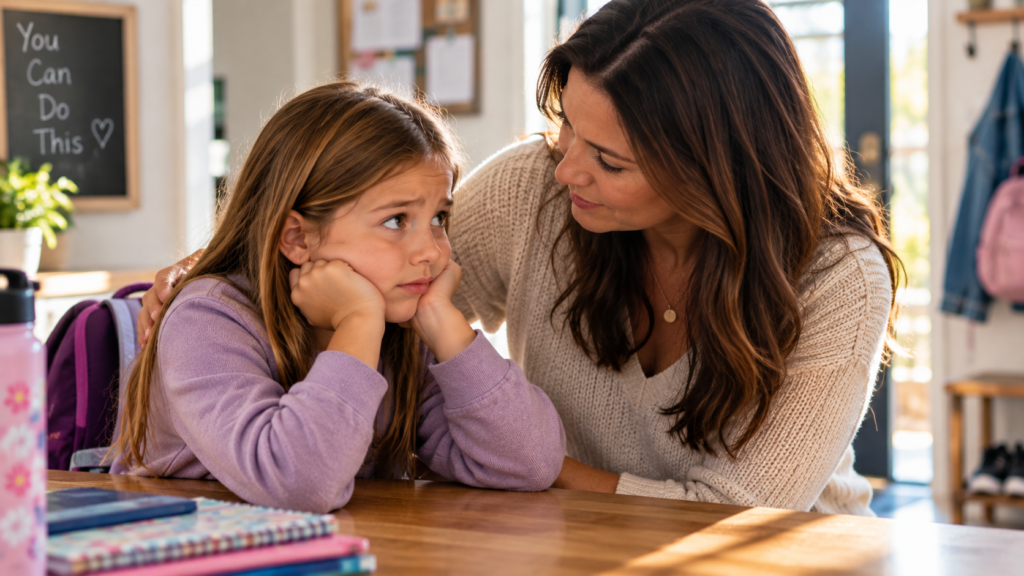
How Should I Talk to a Child Who Is Anxious About School?
Start by listening before solving.
When our children are distressed, it is natural to want to make the distress disappear. We reassure, explain, offer solutions, or remind them of all the reasons school will be okay.
But sometimes children need to feel understood before they are ready to problem-solve.
You might say:
“I can see that tomorrow is feeling really big. Do you want to tell me what you’re thinking about?”
Or:
“When you imagine going to school tomorrow, what part makes you feel the most worried?”
Then listen.
Try not to immediately challenge what they say, even if their fear seems unlikely.
If your child says, “Nobody is going to talk to me,” jumping immediately to “Of course they will!” may stop you from discovering what is underneath the statement.
Instead, you might respond:
“You’re worried you might feel alone. That sounds really hard. Is there a particular part of the day you’re thinking about?”
That conversation gives you information. And information helps you and your child identify what kind of support might actually help.
Should I Reassure My Child That Everything Will Be Fine?
Reassurance can be comforting, but certainty isn’t always what an anxious child needs.
We cannot promise that every school day will be easy. A child may have an awkward interaction, struggle with an assignment, forget something, or feel nervous walking into a new classroom.
Instead of promising a problem-free experience, help your child build confidence that they can handle challenges with support.
Try shifting from:
“Don’t worry. Everything will be fine.”
To:
“I don’t know exactly what tomorrow will be like, but we can think through what might help you feel more prepared.”
This creates a different kind of confidence.
The message becomes: You don’t have to know exactly what will happen in order to know you can handle what comes next.
How Can Routines Reduce Back-to-School Stress?
Predictability can make transitions easier.
When mornings become a stream of commands — “Get dressed. Eat breakfast. Find your shoes. Brush your teeth. Get your backpack!” — stress rises quickly for everyone.
Instead, involve your child in creating the routine.
Ask:
“What needs to happen before we leave for school?”
Let your child help identify the steps. Younger children may benefit from a visual routine using photographs or simple pictures. Older children can create their own checklist or decide what needs to happen the night before.
The important part is ownership.
When children participate in creating the plan, parents can spend less time directing every movement and more time supporting the routine everyone has already agreed upon.
Healthy boundaries still matter. School starts at a particular time. The family needs to leave the house. Bedtime may need to shift.
Conscious parenting doesn’t mean eliminating boundaries. It means holding boundaries while reducing unnecessary control, threats, and power struggles.
What Can I Do the Night Before School?
If mornings are stressful, move as many decisions as possible to the night before.
Your child might choose clothes, pack their backpack, prepare anything needed for activities, and decide what they want for breakfast.
But emotional preparation matters too.
Instead of ending the evening with reminders about everything your child needs to remember, create a moment for connection.
You might ask:
“What are you looking forward to tomorrow?”
Then:
“Is there anything about tomorrow that you wish felt easier?”
Both questions matter.
One creates space for anticipation. The other creates space for honesty.
What Should I Do When My Child Refuses to Go to School?
School refusal can be incredibly stressful for families, particularly when everyone is under pressure in the morning.
If your child says, “I’m not going,” notice your own reaction first.
It is easy for fear to turn into control:
“You have to go.”
“We are not doing this again.”
“If you don’t get dressed right now…”
The more threatened or controlled a child feels, the more likely you may be to see Retaliation, Rebellion, or Resistance, what I call the 3Rs.
Instead, pause and become curious about what is driving the refusal while maintaining the necessary boundary.
You might say:
“I hear that you really don’t want to go today. Something about school feels very difficult right now. Help me understand what’s happening.”
Understanding the reason doesn’t automatically mean the child stays home. It means you are gathering information before deciding what support and boundaries are appropriate.
Persistent or severe school refusal deserves additional attention. Work collaboratively with your child’s school and, when appropriate, qualified health or mental health professionals to understand what may be contributing to the distress.
How Can I Teach My Child to Manage Anxiety Instead of Avoiding It?
Children benefit from learning that difficult emotions are something they can move through, not something they have to fear.
Start by helping your child notice what happens in their body.
They may describe butterflies in their stomach, a tight chest, shaky hands, racing thoughts, or feeling like they want to run away.
From there, explore simple strategies together. Depending on your child, this might include slowing their breathing, taking a quiet moment before leaving home, talking through what they can control, or identifying one trusted adult they can go to at school.
The goal isn’t to tell your child, “Stop being anxious.”
It’s to help them develop a relationship with their emotions in which they can notice what they’re feeling, understand what it may be communicating, and choose what to do next.
That is emotional regulation developing in real life.
How Do I Help Without Making My Child More Dependent on Me?
Support and independence are not opposites.
The question is whether our support gradually helps children develop their own capacity.
Rather than doing everything for your child, look for opportunities to do things with them and eventually let them take greater ownership.
If your child is nervous about finding a classroom, perhaps you look at the school map together.
If they are worried about making friends, ask what they might say to someone they know.
If mornings feel overwhelming, let them design their checklist.
We can be a secure source of connection while still communicating:
“I believe you are capable, and I’m here while you figure this out.”
That balance helps children experience both support and growing autonomy.
When Should Parents Seek Additional Help for School Anxiety?
Some back to school stress is temporary and eases as children adjust to a new routine.
But pay attention when anxiety is persistent, worsening, or significantly interfering with your child’s ability to participate in everyday life.
For example, you may notice ongoing school refusal, significant sleep disruption, frequent physical complaints, intense distress around separation, or changes in your child’s usual functioning.
You don’t have to figure out the cause alone.
Your child’s teacher, school counselor, pediatrician, or an appropriately qualified mental health professional may be able to help you better understand what is happening and determine what additional support is appropriate.
Seeking support does not undermine conscious parenting. Listening carefully to what your child is communicating and bringing in additional resources when needed is part of responding thoughtfully.
What Is the Most Important Thing to Remember About Back-to-School Anxiety?
Your child doesn’t need you to make every uncomfortable emotion disappear.
They need a relationship in which difficult emotions are safe to talk about.
Back to school anxiety can become an opportunity to practice something much bigger than preparing for another school year: listening without immediately correcting, staying connected during stress, holding healthy boundaries without turning them into power struggles, and helping children develop confidence in their ability to navigate difficult experiences.
When your child is anxious, begin with curiosity.
“What feels hard?”
“What are you worried might happen?”
“What would help you feel more prepared?”
And perhaps most importantly:
“Do you want me to listen, or would you like us to think of some ideas together?”
Sometimes the most powerful thing we can give our children isn’t the perfect solution.
It’s the experience of knowing they don’t have to face a difficult feeling alone.
Frequently Asked Questions About Back-to-School Anxiety
1. Is back-to-school anxiety normal for children?
Some nervousness or back to school stress can happen when children face a new teacher, classroom, schedule, social environment, or separation from home. What matters is how intense the anxiety becomes, how long it continues, and whether it significantly interferes with your child’s daily life.
2. What are common signs of school anxiety in children?
School anxiety in children may appear as worry, irritability, trouble sleeping, stomachaches, headaches, clinginess, repeated reassurance-seeking, morning resistance, or reluctance to attend school. Because children don’t always have the words to describe anxiety, parents may first notice changes in behavior.
3. What should I say when my child is anxious about school?
Begin with curiosity rather than immediately trying to convince your child that everything will be fine. You might say, “I can see that school is feeling difficult right now. What part feels hardest?” Listening first can help you understand what is underneath the anxiety before you begin looking for solutions together.
4. What should I do if my child refuses to go to school?
If school refusal becomes persistent, try to understand what is driving the resistance rather than treating it only as misbehavior. Maintain appropriate boundaries while listening to your child’s concerns. When school refusal is ongoing, severe, or interfering significantly with everyday life, consider working with the school and an appropriately qualified health or mental health professional.
5. How can I reduce back-to-school stress at home?
Create predictable routines and involve your child in planning them. Prepare backpacks and clothing ahead of time, use visual routines or checklists when helpful, make room for conversations about worries, and reduce unnecessary morning commands. The goal is not a perfect routine. It is a family rhythm that provides structure while giving your child an appropriate sense of ownership.
Ready to Create More Connection and Less Conflict at Home?
Back to school anxiety is only one of the moments when the way we communicate with our children can make an enormous difference.
At Conscious Parenting Revolution, Katherine Sellery helps parents move away from power struggles and toward communication built on connection, emotional awareness, healthy boundaries, and mutual understanding.
If you’re finding yourself caught in repeated resistance, arguments, or difficult transitions with your child, explore Katherine’s Conscious Parenting Revolution resources for practical ways to create more cooperation and connection in your family.